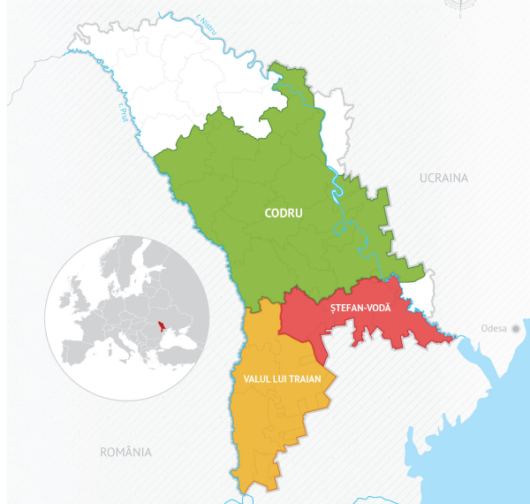
Moldova’s wine identity is structured around 4 Protected Geographical Indications (PGI): Codru (central Moldova), Ștefan Vodă (southeast), Valul lui Traian (southwest), Divin (for brandy/distillates, cross-regional). This classification matters because it reflects climate, soil, and style differences, not just geography. For a traveler, it helps answer a key question: why do wines taste different across the …
Moldova’s wine map: understanding the bigger picture
Moldova’s wine identity is structured around 4 Protected Geographical Indications (PGI):
Codru (central Moldova),
Ștefan Vodă (southeast),
Valul lui Traian (southwest),
Divin (for brandy/distillates, cross-regional). This classification matters because it reflects climate, soil, and style differences, not just geography. For a traveler, it helps answer a key question: why do wines taste different across the country?
What Valul lui Traian actually is
Valul lui Traian covers a large part of southern Moldova, including areas such as Cahul, Comrat, Taraclia, Vulcănești, Leova and Cantemir. It is not a compact or highly curated region. Instead, it is defined by scale and diversity — open plains, rolling hills, vineyard slopes and long distances between key points.
Within it, there are three distinct subzones — Câmpia Bugeacului, Codrii Tigheciului and Terasele Prutului — each with slightly different conditions, but all sharing a warmer climate and strong sun exposure.
This is what makes the region particularly suitable for fully ripened grapes and more concentrated wines.
What gives Valul lui Traian its character is not just the climate, but the combination of soils and geological layers.
The region is built on formations dating back to the Miocene period, with soils dominated by clay, sand and old marine sediments. In certain microzones — such as Ciiumai, Vulcănești or Etulia — there are also reddish deposits rich in microelements, which contribute to the structure and intensity of the wines.
On top of this, large areas are covered by chernozem, the deep black soil typical for Eastern Europe. This type of soil retains water well and supports steady vine development, especially important in a dry southern climate.
The result is a terroir that naturally favors ripeness, extract and consistency, particularly in red grapes.
Why the region is dominated by red wines
Around 60% of vineyards in Valul lui Traian are planted with red varieties, often on slopes with strong sun exposure. This is not accidental — the region is structurally better suited for red wine production. particularly in microzones like Trifești and Ciiumai.
In the glass, this translates into wines that are:
deeper in color (from ruby to dark garnet),
more concentrated,
driven by ripe fruit rather than sharp acidity.
Cabernet Sauvignon and Merlot are the backbone of the region, with Saperavi gaining ground and local varieties like Rară Neagră showing increasing potential when handled carefully.
There is also a long-standing tradition of licoroase (dessert-style wines),

Compared to central Moldova, wines from the south tend to feel more open, generous and sun-driven.
Red wines are the most representative: full-bodied, with ripe fruit (blackberry, plum, dark cherry) and softer tannins. They are often more immediately accessible, without losing structure.
White wines are generally more aromatic and slightly rounder, but still balanced. Rosé wines, on the other hand, are fresh and easy to drink, with light fruit notes and a subtle mineral edge.
Overall, Valul lui Traian produces wines that are less about restraint and more about expression and volume.
Wineries to visit in Southern Moldova
To understand the region, it’s important to see both the more established producers and the smaller, local ones.
Gitana, in the Leova area, is often considered one of the most serious producers in the region, particularly for structured red wines.
In Găgăuzia, wineries like Novak or Kara Gani offer a more local and less polished perspective, but one that reflects the real identity of the region. Even though it belongs to a different PGI, Purcari is frequently included in southern routes and works well as a benchmark for a more established style.
How to plan a visit
Southern Moldova requires a different approach compared to central regions. Distances are longer, infrastructure is less predictable, and routes are not always optimized for fast travel.
For this reason, we recommend either renting a car or arranging a driver with a car, especially if you plan to visit multiple wineries in one day. Public transport is limited and not adapted to wine travel.
A realistic plan usually means one or two wineries per day, with enough time for tastings, meals, and travel between locations. Trying to cover too much in a short time often turns the experience into logistics rather than understanding the region.
Southern Moldova is not the easiest wine region to visit, but it is one of the most revealing.
Valul lui Traian brings together the elements that define Moldovan wine at its most expressive — sun, scale, and a complex mix of soils that favor ripeness and concentration. The result is a style that feels more open, more structured, and often more direct than in other parts of the country.
For travelers interested in wine beyond surface-level tasting, this region offers something essential: context. Not just what Moldovan wine is, but what it can become.
It is best approached with time, realistic planning, and a focus on a small number of well-chosen wineries. Done this way, Southern Moldova is not just a wine trip — it becomes a clearer understanding of the country itself.
If you still have questions or want real, up-to-date advice from people who have already explored Moldova, you can join our community on Facebook. It’s a space where travelers share experiences, ask practical questions, and get honest recommendations before and during their trip.

GuideMoldova.com
Keep in touch with our news & offers
Subscribe to Our Newsletter
Thank you for subscribing to the newsletter.
Oops. Something went wrong. Please try again later.