Rising above the tranquil waters of the Dniester River, Soroca Fortress is one of the most remarkable medieval fortresses in Eastern Europe and one of the greatest symbols of Moldova's history. For more than five centuries, its walls have guarded one of the country's most strategic frontiers, witnessing wars, sieges, and the rise and fall …
Soroca Fortress: The 500-Year-Old Guardian of the Dniester
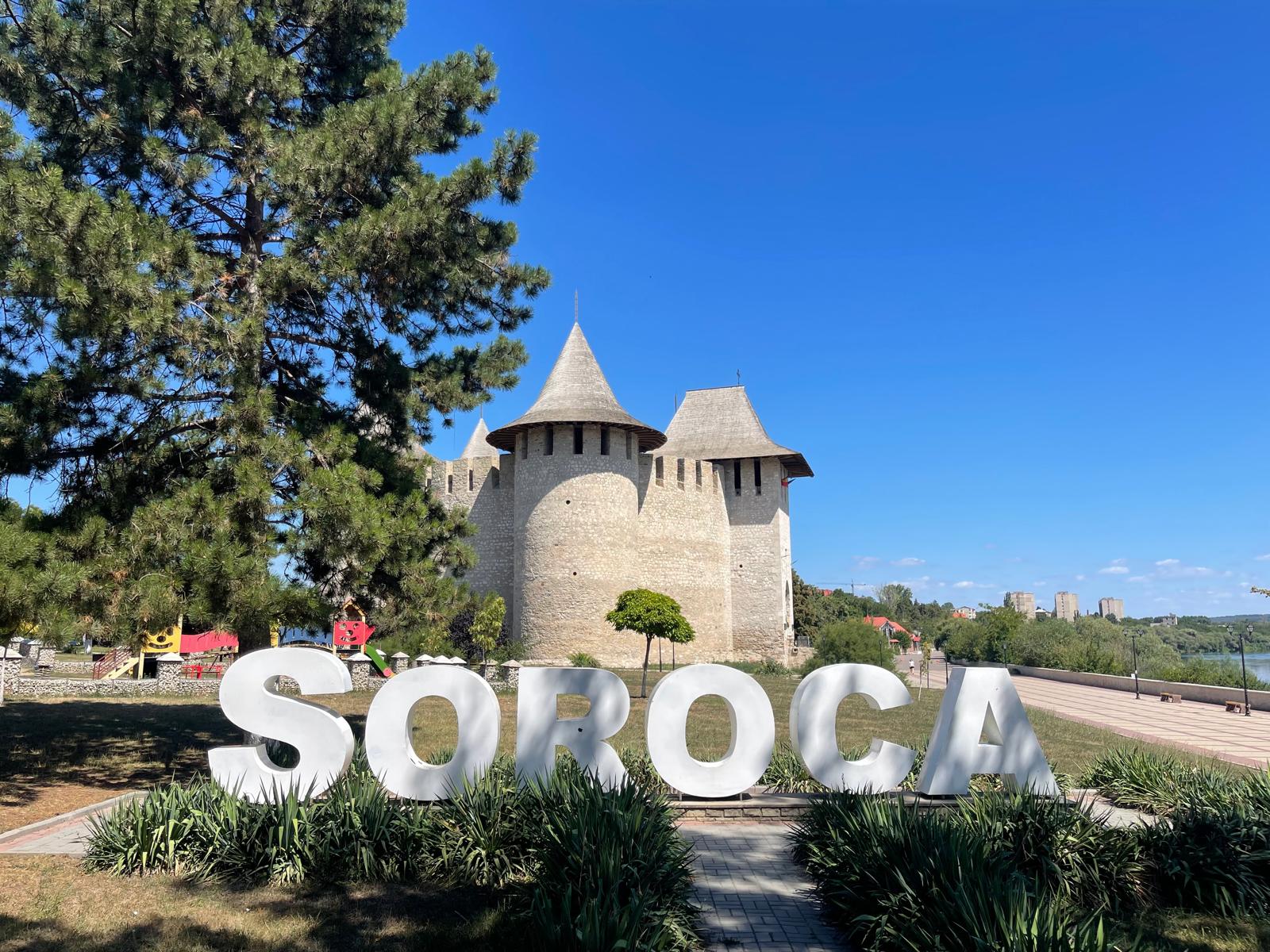
Rising above the tranquil waters of the Dniester River, Soroca Fortress is one of the most remarkable medieval fortresses in Eastern Europe and one of the greatest symbols of Moldova’s history. For more than five centuries, its walls have guarded one of the country’s most strategic frontiers, witnessing wars, sieges, and the rise and fall of empires. Today it is the best-preserved fortress in Moldova and one of the country’s most visited historical landmarks.
The Birth of the Fortress
The origins of Soroca Fortress date back to the reign of Stephen the Great, the ruler who transformed the Principality of Moldavia into one of Eastern Europe’s strongest states. Around 1499, he ordered a wooden fort built here to defend a key crossing over the Dniester, part of a wider defensive chain that also included the fortresses of Akkerman (Cetatea Albă) and Khotin along the same river, plus outposts on the Danube and along Moldavia’s northern border.
Local tradition offers a charming explanation for the town’s name: it’s said the ruler gave his builders a “sorok”, forty days, to finish the job, and the name Soroca stuck. Archaeological digs inside the fortress have confirmed there really was an earlier wood-and-earth structure on the site before the stone version replaced it.
As artillery grew more powerful, wooden walls stopped being good enough. Under Petru Rareș, Stephen the Great’s son, the fortress was rebuilt entirely in stone between 1543 and 1546, a rebuilding effort documented in surviving correspondence, including a letter from Rareș requesting master masons for the job.
A Circle Built on Mathematics
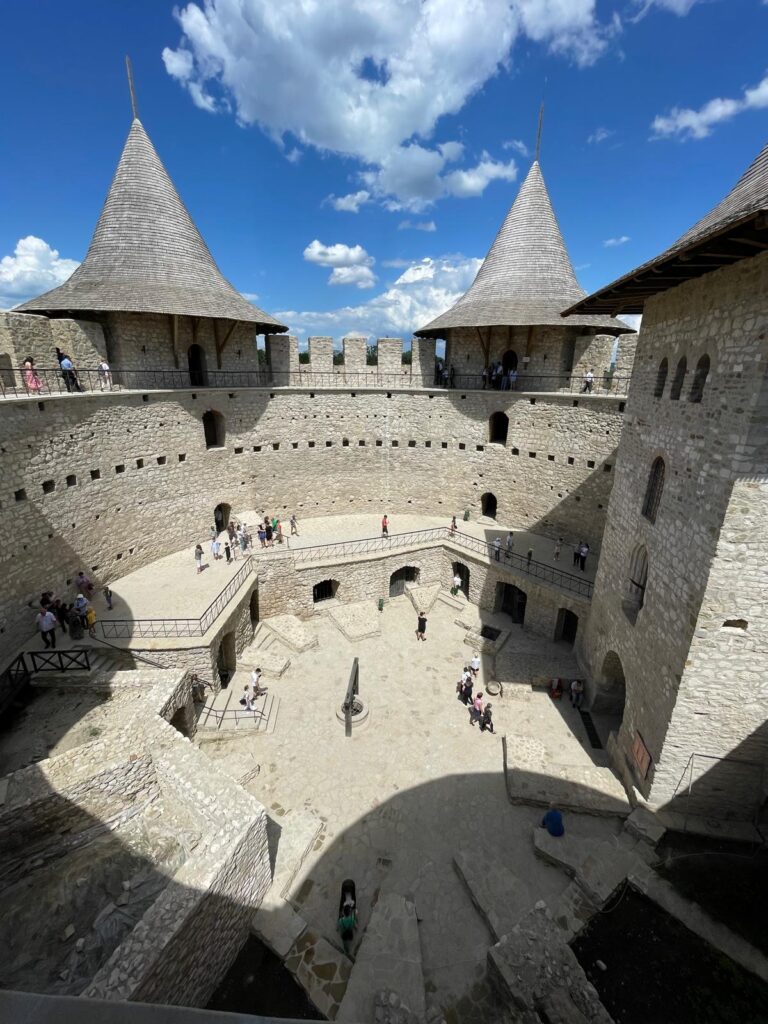
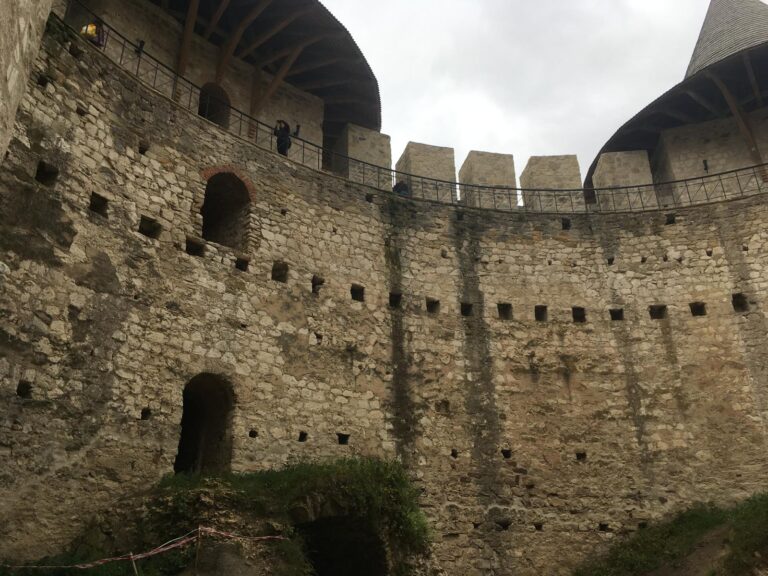
Unlike most medieval castles, Soroca Fortress was laid out as a near-perfect circle, 37.5 meters in diameter, with five bastions—four rounded towers plus one rectangular tower that doubles as the main entrance—spaced at equal intervals. The layout is often said to follow the golden ratio, giving the design a geometric harmony that still draws architects and historians today. The walls run more than three meters thick and rise about 20 meters high, engineered to deflect cannon fire rather than absorb it head-on.
Inside, defenders once moved along three tiers of wooden galleries built on cantilevered beams, entering the tower rooms via external staircases. A chapel with a pointed Moldavian Gothic archway sat directly above the entrance passage, and a well was sunk at the center of the courtyard to keep a water supply available during a siege.
Centuries of Sieges
Soroca’s small garrison—usually somewhere between 80 and 250 soldiers—held this stretch of the Dniester against a long list of attackers: Tatar raiders, Ottoman forces, Cossack fighters, and Polish-Lithuanian troops all tested its walls over the centuries. A few episodes stand out:
- During the Great Turkish War, forces under Polish king John III Sobieski successfully held the fortress against an Ottoman siege.
- In 1711, during the Pruth River Campaign, the fortress served as a rallying point where the army of Moldavian prince Dimitrie Cantemir joined forces with the Russian army under Sheremetyev, allied against the Ottomans.
- The fortress was later sacked by Russian forces during the Russo-Turkish War of 1735–1739.
The Legend of the White Stork
No story captures Soroca’s spirit better than the legend of the white stork. As the tale goes, during a long siege, usually placed in the Tatar or Ottoman invasions, the defenders’ food and water ran out and death by starvation seemed certain. Storks that nested in the fortress towers, spared by the soldiers years earlier, returned the favor: they flew in carrying grapes in their beaks and dropped them to the starving men below, giving them the strength to fight on and eventually win. Ever since, the stork with grapes in its beak has been one of Moldova’s best-loved folk symbols, appearing on everything from coins to wine labels.
A second, lesser-known legend claims a secret tunnel once ran from the fortress well, under the Dniester, to the opposite riverbank, though historians remain divided over whether it ever existed or has simply been swallowed by groundwater over the centuries.
Restoration and What You’ll See Today
Soroca Fortress has gone through several rounds of EU-backed restoration in the past fifteen years. Between 2013 and 2015, it was restored as part of “Medieval Gems,” a cross-border project that also covered the fortresses of Suceava (Romania) and Khotyn (Ukraine). A second, more extensive phase ran from 2021 into 2023 under the “Ștefan cel Mare: Common History – Shared Heritage” program, a joint Moldova–Romania initiative that added protective roofs to all five towers and reinforced the aging stonework.
Walking through the fortress today, you enter through the original rectangular gate tower, cross a compact courtyard ringed by the five bastions, and climb narrow stone staircases up to the ramparts for sweeping views over the Dniester and the Ukrainian riverbank beyond. The interior itself is modest by design—Soroca was built as a garrison outpost, not a royal residence—so exhibits are limited, but the structure and the view are the main draw. Entry runs around 30 Moldovan lei (roughly €1.50), and the fortress is typically closed Mondays and Tuesdays, so it’s worth checking hours before making the trip.
Beyond the Fortress: Exploring Soroca
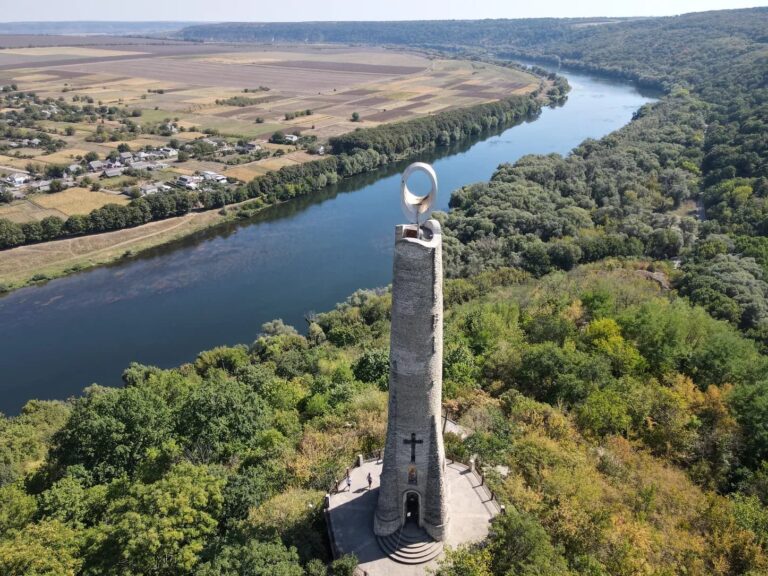
Soroca rewards a full-day visit beyond the fortress walls. The Candle of Gratitude—a striking candle-shaped monument on Bechir Hill, built in memory of the anonymous author of the folk ballad “Miorița”—offers a panoramic view over the fortress, the river, and the town. Nearby, Gypsy Hill (Dealul Țiganilor) is a neighborhood known for its eclectic, often flamboyant houses built by members of Soroca’s Roma community, many modeled after famous buildings from around the world. The riverside promenade along the Dniester rounds out an easy day trip from Chișinău, about a two-and-a-half-hour drive north.

GuideMoldova.com
Keep in touch with our news & offers
Subscribe to Our Newsletter
Thank you for subscribing to the newsletter.
Oops. Something went wrong. Please try again later.