Photo credit: agentiaizvordecultura I’ve always been fascinated by how different cultures express themselves through traditions. You probably feel the same when you travel - the small things, the rituals, the way people celebrate together.Moldova, despite sharing influences with its neighbors, has its own traditions that feel distinct once you experience them in real life. One …
Hora, Rhythm, and Ritual: How Traditional Dance Still Lives in Moldova
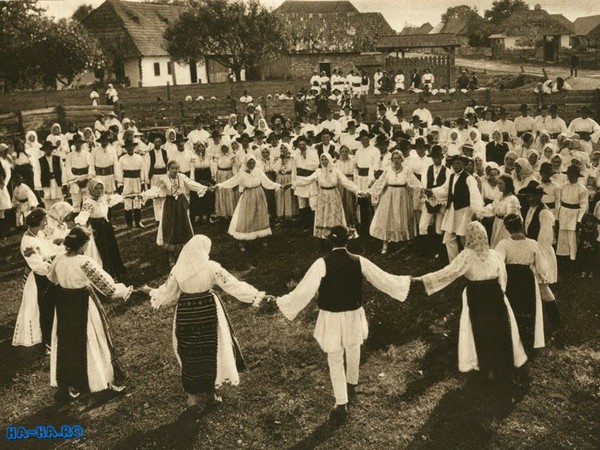
Photo credit: agentiaizvordecultura
I’ve always been fascinated by how different cultures express themselves through traditions. You probably feel the same when you travel – the small things, the rituals, the way people celebrate together.
Moldova, despite sharing influences with its neighbors, has its own traditions that feel distinct once you experience them in real life. One of the most visible – and most meaningful – is the hora.
If you’ve never heard of it before, the hora is a traditional circle dance where an entire group joins hands and moves together in rhythm. It usually starts simply: a few steps forward, a few steps back, the circle slowly turning, most often counterclockwise. But what matters is not the precision of the steps – it’s the fact that everyone moves together.
It’s the kind of experience that is much easier to understand when you see it than when you read about it.
So before going further, take a moment to watch a real Moldovan hora in action:
https://www.youtube.com/watch?v=HAnVINwMc1U
If watching it for the first time gives you the impression that you need to be a skilled dancer or spend weeks learning the steps, that’s not really the case.
It’s true that Moldova has professional folk ensembles – like Joc Ensemble – performing highly choreographed and technically demanding versions on stage. But what you see there is only one side of the tradition.
The version you will actually encounter as a visitor is much simpler. You can pick up the basic rhythm in a few minutes, and most locals will be more than happy – even excited – to show you how it works. The dance is designed to include, not to impress.
Different Types of Hora and Folk Dances
Once you look a bit closer, you’ll realize that what is commonly called “hora” is actually part of a much wider family of traditional dances, each with its own rhythm, structure, and social meaning. Some dances are fast and energetic, like the sîrba, performed in a quick 2/4 rhythm, where dancers often hold each other by the shoulders and move with a more dynamic, almost playful intensity: https://www.youtube.com/watch?v=Kfp7Nu3bDJo
Others, like the bătuta, are more technical and often associated with male dancers, involving sharper footwork and more virtuosic elements: https://www.youtube.com/watch?v=NzjiS7fynYo
The classic hora, in its most recognizable form, can be danced by both men and women, usually in a circle or semicircle, holding hands and moving in a steady, shared rhythm.
There are also more specialized forms, such as ostropăț (I know, we have funny names), traditionally linked to ritual contexts, often performed individually and sometimes involving symbolic objects: https://www.youtube.com/watch?v=_yB3SOXK1D4&list=RD_yB3SOXK1D4&start_radio=1
A particularly important variation is the hora mare, usually danced at a slower or moderate pace, where participants hold their hands slightly raised, creating a more structured and ceremonial feel.
What connects all of them is not just the movement, but how naturally they fit into everyday life. These dances didn’t appear as performances – they grew out of real moments: celebrations, work, rituals, gatherings where people simply came together. Some are tied to holidays or weddings, others reflect daily life, humor, or even stories about people and nature.
If you travel a bit through Moldova, you’ll start noticing that the hora doesn’t feel exactly the same everywhere.
In the central part of the country, around places like Nisporeni, Călărași or Chișinău, I’ve seen it most often during local celebrations – especially at village festivals or hram. There’s a certain energy to it, something lively but still very grounded, like in the well-known Hora de la Nisporeni.
In the north, the rhythm feels faster. The steps are quicker, the whole circle moves with more intensity, and you can feel how the local music shapes that energy.
In the south, especially in Găgăuzia, it changes again. The movement feels slightly different, influenced by a mix of Moldovan and Balkan traditions. Even if you don’t know exactly why, you can feel that it’s not quite the same dance anymore – and that’s what makes it interesting.
For me, that’s when it really clicked: the hora isn’t just one fixed dance. It shifts depending on where you are, who you’re dancing with, and what kind of moment you’re part of. And at the end of the day, that’s exactly why it’s so easy to connect with – no matter where you join it.
What It Feels Like from the Inside (more personal, local voice)
For me, the hora was never something I had to “discover.” It was always there. I grew up seeing it at village celebrations, at weddings, at festivals – especially during hram (the day of the city or village), when the whole place comes alive. Music starts, people gather, and before you even realize it, the circle is already formed.
Nobody announces it. It just happens.
As a kid, I remember standing on the side at first, watching the adults. Then slowly getting pulled in – sometimes by the hand, sometimes just by following the circle. That’s how most people learn it here. Not by instruction, but by being part of it.
And honestly, that doesn’t really change with age.
Even now, when you step into a hora, there’s always that first second where you try to catch the rhythm. You look left, you look right, you adjust. But it only takes a moment before it starts to feel natural again. Because the hora carries you. You don’t have to be precise. You don’t have to be good. The people next to you will guide you without saying anything – just through the movement, through the rhythm.
That’s why, when I see visitors hesitating on the side, I already know what will happen next. Someone will take their hand, the circle will open, and in a few minutes they’ll be smiling, trying to keep up, already part of it.
And that’s the thing I think is hardest to explain from the outside.
The hora is not something you watch and then decide to join.
You join first – and only then you understand it.

GuideMoldova.com
Keep in touch with our news & offers
Subscribe to Our Newsletter
Thank you for subscribing to the newsletter.
Oops. Something went wrong. Please try again later.